Richard Dannatt, Allen Packwood, Churchill’s D-Day: The Inside Story (London: Hodder and Stoughton Limited, 2024).
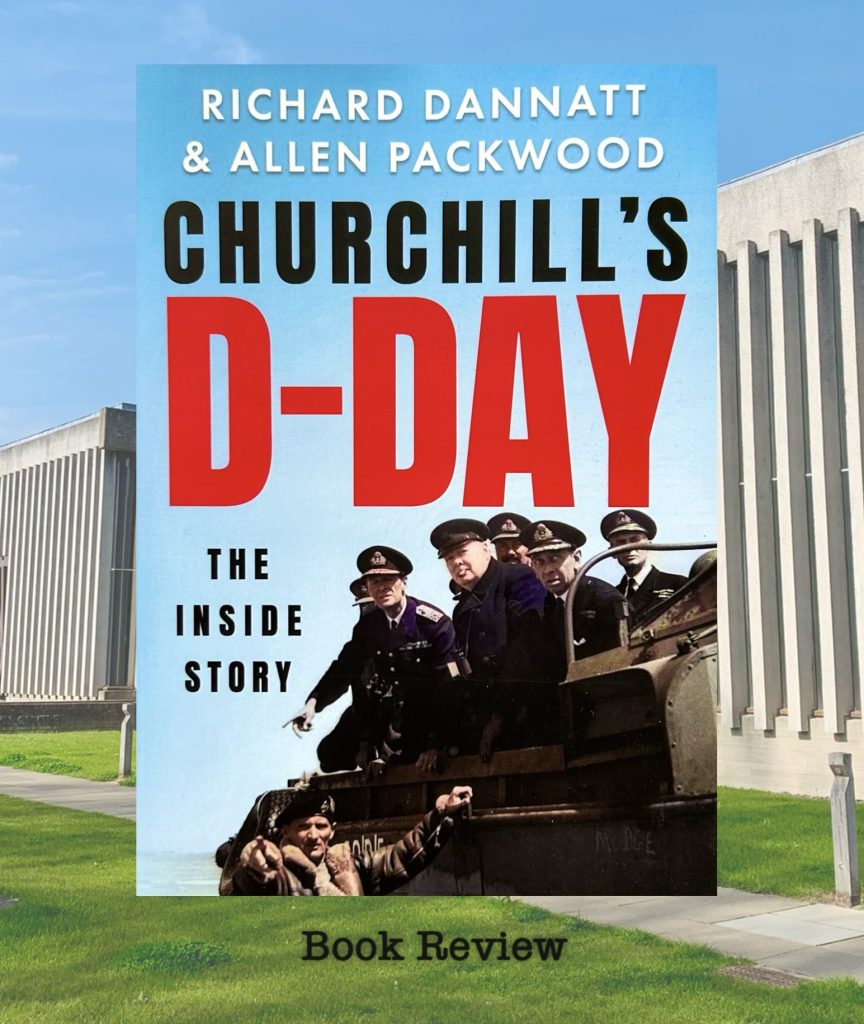
Stripping back the layers of hindsight, Richard Dannatt and Allen Packwood provide a fascinating insight into Winston Churchill’s vital role in the planning, preparations, and execution of D-Day, 6 June 1944, codenamed Operation Overlord. Much of the modern history produced on Churchill’s role during the Second World War focuses on his contributions in 1940 and the Battle of Britain. Focusing primarily on the later years of the war and the events that led to D-Day, this book expertly demonstrates Churchill’s importance in creating the alliances and frameworks for Operation Overlord that would eventually liberate France and lead the Allied forces to victory.
A key feature of this study is considering the ghosts and lessons from Churchill’s past. Although Churchill did not develop the plans for Overlord, he was aware of the problems the operation faced and used his prior experience of war and powers of patronage to advance and support those working to overcome them. Perhaps one of the greatest lessons of Churchill’s pre-war career was Gallipoli. There are also those lessons learnt from the operations prior to Overlord. Operation Jubilee saw the disaster at Dieppe, which proved to many that they were not ready for a large-scale invasion such as Overlord. Slapton Sands in Devon, which resembled Utah Beach, one of the selected locations for the D-Day landings, was used for practice runs of landings. Tragedy struck during one practice when 749 US soldiers and sailors lost their lives when struck by E-boats. Evaluating these events and their lessons, Dannatt and Packwood provide an image of how they influenced the dictation of Overlord and how it became clear that Overlord could not be considered in isolation.
Previously, historians and contemporary journalists have tried to claim that Churchill was not fully supportive of Overlord. This is far from true. Of course, Churchill had concerns. All involved in the operation did. As the authors demonstrate, Churchill’s caution towards it was not due to distrust in the plan or in those planning it but can be put down to the responsibility of life on his shoulders. It was not only the security of the country that Churchill sought to protect but the safety of the lives of those at the frontline. He feared the death toll both among combatants and civilians, and the potential impact it could have on post-war Europe.
Assessing the special relationship between Great Britain and the United States, Dannatt and Packwood discuss the complexities of this relationship and its importance for Churchill. The authors demonstrate that, like all relationships, it took time to build. Many forget that the sentiments of brotherhood, which symbolised the alliance at the end of the war, were not universally shared in 1942. Building close political and military ties and building trust between its forces took time, but the alliance and teamwork that developed from it proved vital to making Overlord possible.
Delving into the lives of other influential and vital figures in Overlord’s success, Dannatt and Packwood offer unique insights into these individuals and their role in the wider picture of the operation. Joan Bright is one of these figures who is mentioned at many stages of the Overlord story. Bright was part of a new clandestine unit within the British Secret Service that was charged with planning subversion and sabotage behind enemy lines. She became ‘a keeper of official secrets’ and was one of few who was aware of the ‘final pieces of the intelligence jigsaw’ that would make the deception planning of Overlord possible. Bright also led the British administrative arrangements for the Washington, Quebec, Moscow, Yalta, and Potsdam summits. She attended them all, something which before the war would have been extremely rare. Focusing on Bright’s influential career, the authors provide a vital image of women’s role in intelligence during the Second World War alongside the story of Overlord.
Removing hindsight and studying events in their context, Dannatt and Packwood provide a detailed analysis of Churchill’s role in the timing and nature of Overlord, as well as the complex nature and less confident story surrounding the planning and preparations for the operation’s success.
 Elliot Clark HISTORIAN
Leave a comment