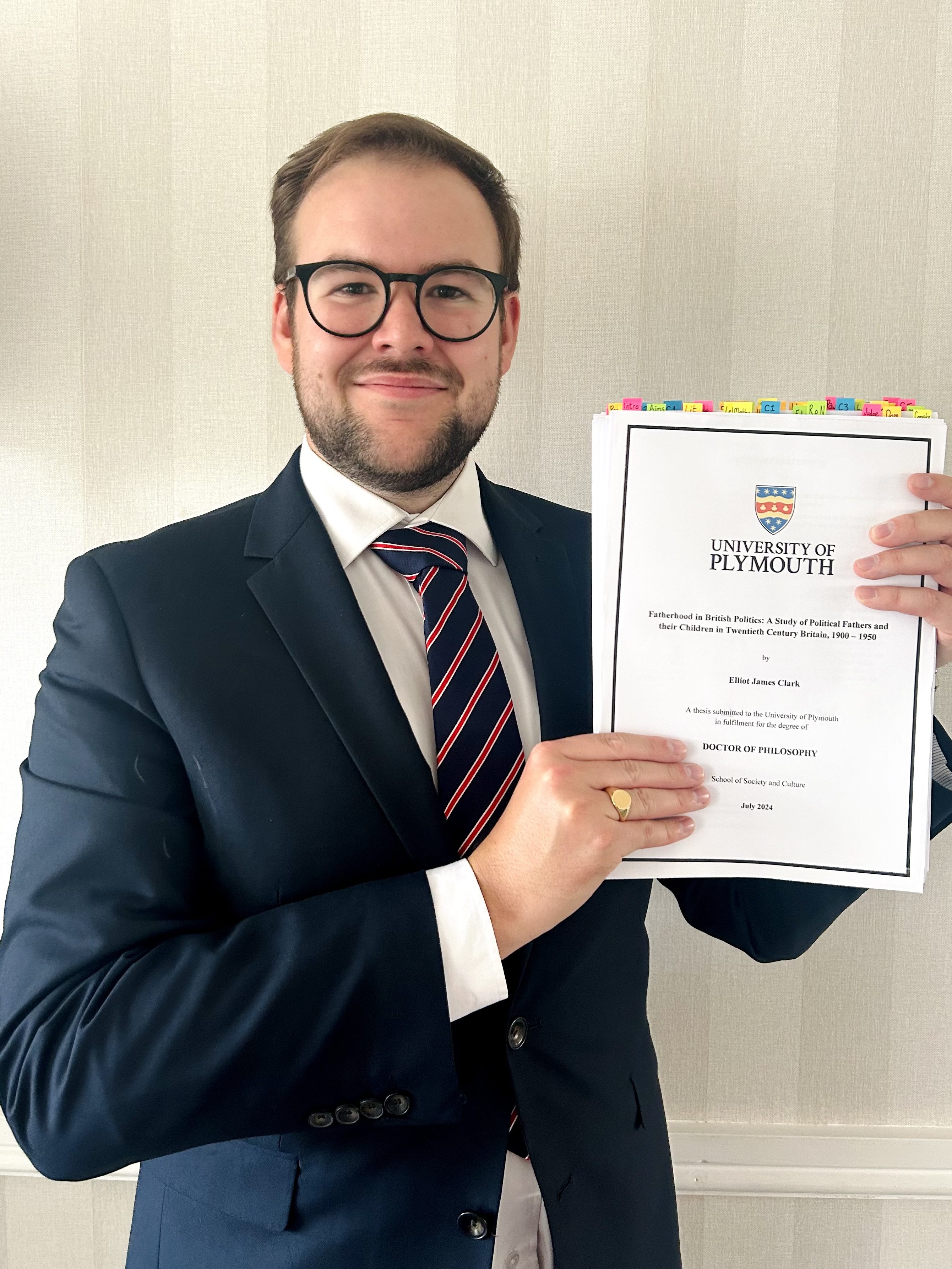
Dr Elliot Clark writes, ‘I am thrilled to announce that I successfully defended my PhD thesis at the viva voce examination and passed with no corrections.
‘Embarking on my academic journey as an undergraduate student seven years ago I never thought I would achieve what I have today. This success is widely thanks to the expert support and guidance of the History department team at the University of Plymouth. Working with the team I have been able to cultivate my skills as a historian and develop an enhanced understanding of approaches to academic research. I have thoroughly enjoyed the opportunities and experiences I have gained from my time at the University of Plymouth and look forward to sharing some of my research with the wider world.
‘A special thank you to my director of studies, Dr Harry Bennett and supervisor Dr James Gregory for their constant support and counsel throughout the production of my PhD.’
Clark’s thesis, titled ‘Fatherhood in British Politics: A Study of Political Fathers and their Children in Twentieth Century Britain, 1900 – 1950’, explores the private lives of nine eminent British politicians and how they approached fatherhood in the context of their class and broader culture. By analysing how politicians raised and educated their offspring, their parenting styles, and studying how their political careers impact their family life, the thesis seeks to deepen understanding of their personal lives and public personas. This offers a fascinating new insight into the values, beliefs, and character of a political class in Britain and the evolving political and social landscape in the first half of the twentieth century.
Clark’s Director of Study, Dr Harry Bennett writes, ‘Over seven years of teaching Elliot at undergraduate and postgraduate level I’ve watched him mature into a young and capable historian with a bright future ahead of him. He brings fresh thinking and a different approach to British political history, humanising the inner lives of some of the great political families of the twentieth century.’
 Elliot Clark HISTORIAN
Leave a comment