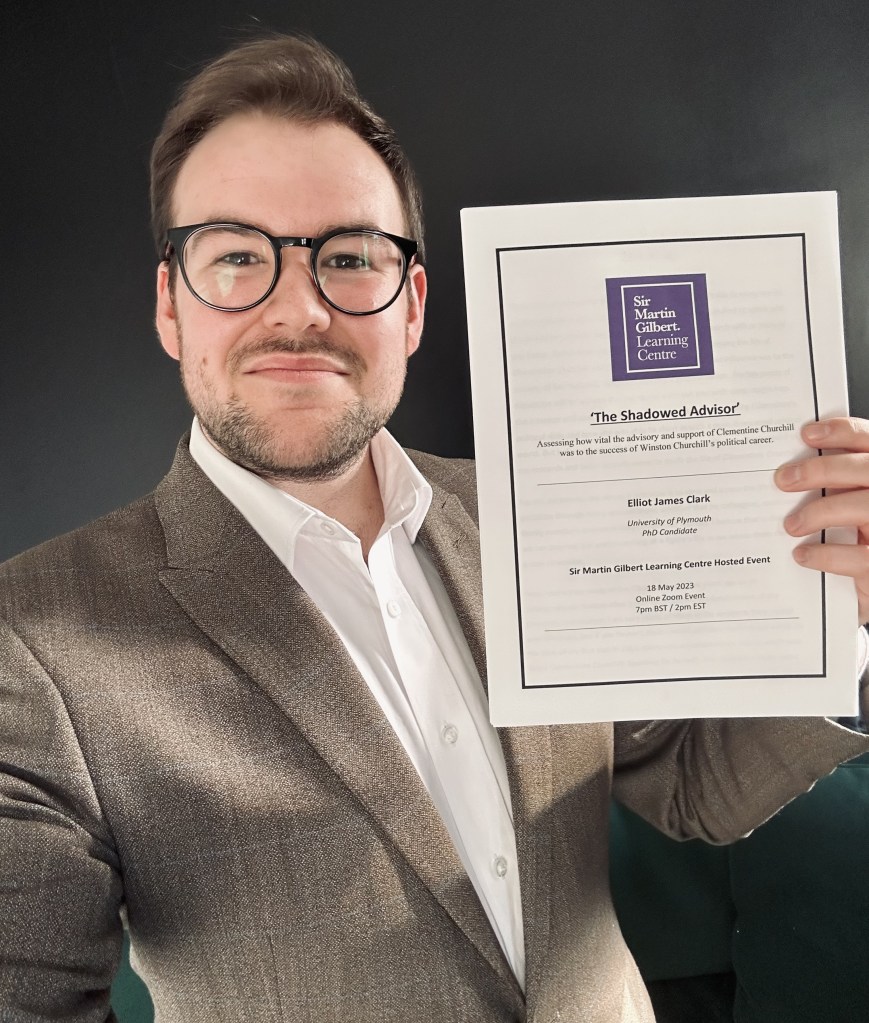
This is a section of the talk presented by Elliot Clark for the Sir Martin Gilbert Learning Centre on May 18th 2023. The event was hosted by Dr Bethany Gaunt.
In Britain’s hour of need, Winston Churchill became the nation’s wartime Prime Minister on May 10th, 1940, with his wife Clementine’s role also now intensifying. The lessons and skills which Clementine had to learn and utilise during the First World War, as a confidant to her husband, political advisor, and a woman of war, would all become crucial skills with her husband now at the helm. During the Second World War, Clementine became a popular public figure in her own right, not only for her work alongside her husband but for her own war work as well. Clementine was far more than a biddable political wife. Her strengths went beyond that of her predecessors which, to begin with, caused some concern to Downing Street staff. Churchill’s private secretary, Jock Colville, recorded in his diary how Clementine saw ‘her mission in life to put others in their place and took pride in her outspokenness.’ [Hardwick, p.244]. Despite these initial concerns the Downing Street staff soon recognised how crucial Clementine would be for them in maintaining Churchill, with her being one of the few people Churchill would truly listen to.
When there was a matter in government, Clementine would be notified by staff in an attempt to resolve it when others were unable to. For example, on June 27th, 1940, after hearing word from Cabinet of concern over Churchill’s attitude, Clementine in a letter to Churchill warned him ‘there is danger of your being generally disliked by your colleagues’, as she informed him, ‘you are not so kind as you used to be.’ [CA, CSCT-1/24]. After this letter, Colville recalled how Churchill’s ‘ill-tempered phases’ had passed, and Clementine’s warning proved a success. [Purnell, p.219].
It must be questioned here why Clementine made this warning to Churchill in a letter. One of the ways Clementine had learned to understand Churchill’s mind was that he would take note, and act upon something, much more effectively when presented to him in writing rather than verbally communicated to him. Therefore, Clementine ensured that when an issue of importance came up it would always be communicated to her husband via letter. This was a technique that Clementine advised both ministers and family members to use and can be seen throughout various collections of correspondence. Clementine had learnt to control and mediate Churchill better than anyone and often proved a great support to those working with Churchill when mediation was required. On occasions to prevent unrest, Clementine would proclaim, ‘Now Winston, that’s all right, the subject can be let to rest for the moment.’ General Sir Fredrick Pile, who observed these mediation skills recalled how ‘She bossed him – but in the most delightful way… with the deepest understanding of his nature.’ [Purnell, p.133].
Even when it came to matters such as Churchill’s safety, Clementine would once again be called upon. It is well known that Churchill took great excitement and interest in danger but when Prime Minister, and leading the nation, his safety became a major concern. Various politicians from the period have noted how Churchill took them to the roof of Number 10 at night to observe the battle in the sky. With others unable to prevent this, to ensure his safety, Clementine uniquely authorised an ‘espionage network’ of staff who would inform her when her husband sought to go out into danger. During the height of the Blitz, Churchill would also often leave the safety of Number 10 completely and go into the bombed streets of London to observe the damage inflicted. This caused great panic as Ministers attempted to stop him but to no prevail. In manipulating Churchill, to prevent him from going out, Clementine joined him in the danger. General Ismay recalled how, ‘this time concerned for her safety, he returned before nightfall.’ [Purnell, p.234]. It is apparent that Clementine ultimately put herself in harm’s way to prevent her husband from continuing with such endeavours, as he now realised she would accompany him and he did not want her in any danger. This was a subtle action but portrays that Clementine knew precisely how to manage Churchill and protect the man needed to lead the war.
Other examples of this technique include when Churchill refused to use the bulletproof car which was provided to the Prime Minister. Learning of this refusal, and to ensure that Churchill had no choice but to use it, Clementine would ensure that all other cars were away from Downing Street leaving the Prime Minister with no other choice. Again, this was another small act but a crucial one. On one trip shrapnel in fact hit the side of the bulletproof car which Churchill was travelling in. If this had been an ordinary car the consequences could have been catastrophic. Clementine’s skill of manipulating Churchill away from the danger was heavily relied on for the entirety of the war and her ‘espionage network’ proved a great success in protecting the Prime Minister.
As mentioned, Clementine’s popularity was enhanced through the war as she was often seen accompanying her husband on many of his Blitz tours around the nation. It became clear the public in fact longed to see her, just as much as they longed to see her husband. It was Lord Ismay who stated that the public regarded Clementine as an ‘angel of mercy’ who possessed a ‘great calming effect on others.’ [Fishman, p.142]. This certainly proved to be the case. When on tour of the blitzed city of Plymouth in May 1941, images were published in the press showing Clementine as a major player in Churchill’s entourage. One observer in Plymouth wrote how, to quote, ‘there was much pleased feminine comment on Mrs Churchill’s striking appearance; snow-leopard coat with flounced sleeves, a coloured handkerchief over her head with phrases of her husband’s speeches printed on them.’ [Soames, p.339].
It may seem odd that it was Clementine’s fashion which is commented on however, it can be argued that Clementine’s distinctive style acted as a morale boost for many as it demonstrated the nation’s courage with the symbolism of her husband’s speeches on the headwear. This image of Clementine was partly one constructed by the press, similar to how the media comments on a politician’s fashion today, but also one utilised as a weapon by Clementine and Number 10 as they recognised its power in providing the public with some glamour in a time of darkness as it portrayed brighter days to come. Examining the damage and talking to members of the public allowed Clementine to connect with them, not only as a public figure, but as a woman, wife, and mother. This created a personal touch to Clementine’s relationship with the British people and it’s here that we see the ‘great calming effect’ that Lord Ismay described from Clementine’s presence on such tours.
Clementine proved throughout the war that she could connect with the people openly, not only through these tours but through her public broadcasts. These interactions proved successful not only in Britain but abroad as well. In a 1944 broadcast in the United States, Clementine spoke of the ‘unity’ between Britain and the US and thanked them for their ‘noble aid.’ She commented, to quote, “Out of that unity has sprung the wonderful strength and efficiency we have seen on the battle-front today. Let us give these Joint Forces of our united people every ounce of support in their tremendous enterprise. Let us see them through.” [CA, CSCT-3/44/21]. Through the public’s reaction, it became clear that Clementine had won over the American public with the Washington Times announcing her to be ‘Winston’s greatest asset.’ A statement which at times was echoed around the world. Her global popularity was further reflected through her growing postbag of letters from admiring fans.
Clementine’s own work at times meant she was unable to accompany her husband. Aware of this, she ensured that a member of the family would always be available to do so when she could not be around. This duty would often fall upon one of the daughters, ordinarily either Sarah or Mary. As a role model to her daughters, Clementine demonstrated a woman’s skills and ability in the male-dominated political world. She had proved to many, including her husband, what a woman could achieve politically, even though not a minister herself. Growing up around their mother, and undertaking their own work in women’s services, with Mary in the ATS and Sarah in the WAAF, meant they had both received significant training to undertake the role of their father’s ADC. In 1945, Sarah accompanied her father to the Yalta Conference. In a letter to her mother, Sarah notes that Churchill commented to her while in Yalta ‘I do not suppose that at any moment in history has the agony of the world been so great or widespread. Tonight, the sun goes down on more suffering than ever before in the world!’ [CA, MCHL-5/1/20]. While reporting her father’s progress and her experiences, Sarah described how she had seen some of that agony in Russia. When unable to accompany her husband, Clementine ensured that her family kept her updated on his operations, with letters such as this, to allow her to continue monitoring his progress.
It was with her own war work that Clementine’s talents as a political figure and humanitarian truly shone. In succeeding Lady Halifax as President of the Young Women Christian Association, in February 1941, Clementine took on the responsibility of the appeal. During her duration as President from 1941 to 1949, Clementine helped raise over £1,250,000 for the funds with donations being requested through public broadcasts and newspapers. [CA, CSCT-3/65/1]. For example, on June 11th, 1945, The Times published a report from Clementine requesting donations to help raise £200,000 for the organisation to allow it to continue its vital work in supporting women workers. [TDA, Iss.50165, June 11th, 1945]. These funds were used to provide new hostels and canteens for women war workers, many of whom would have been far from home. Even after the war, Clementine’s commitment to the organisation continued and, on March 23rd1947, she announced that twenty-two new hostels had been opened over the year, a significant success despite the lack of funds. [CA, CSCT-3/65/4]. Jock Colville was one who recognised Clementine’s growing success in such organisations. He wrote in his diary, on March 3rd 1945, that Clementine ‘could not have done her job better’ or addressed an audience more ‘effectively when called upon to do so.’ [Colville, p.538].
Amongst all of Clementine’s personal war work, the most significant was with the Aid to Russia Fund which she became Chair of in 1941. The fund was set up with the aim of raising money to send to Russia to help provide medical supplies and clothing. With the use of public appeals, in its first twelve days of operation, the fund raised £370,000, and by December 1941 it had already exceeded its initial target of raising £1 million. [CA, CHAR-20/204B/147-162]. For her success with the fund, in 1945 Clementine was invited on a tour of Russia by the Russian Red Cross. When on the tour, Clementine wrote to her husband, on April 12th, describing the devastation she had witnessed with children being treated for ‘starvation’ as a result of the blockade. [CA, CSCT-3/49/16]. Despite the suffering, the entourage was met by the adoring Russian public with Clementine writing how they were ‘mobbed by friendly crowds.’ [CA, CSCT-3/49/51]. Grace Hamblin, Clementine’s private secretary, who had accompanied her in Russia, recalled how the fund aimed to provide ‘500 beds to each large hospital’ but once Clementine had seen the devastation for herself it was decided the ‘provision of beds should be doubled.’ [ CA, HAMB-1/4]. By the end of 1948, the Red Cross had raised £7.8 million under Clementine’s fund.
The Russia Fund also provided significant political opportunities for Churchill with the prospect of improving international relations with Russia. In a top-secret telegram to Clementine, Churchill requested that while on tour she expressed his ‘desire’ for a ‘continuing friendship’ with Russia to enhance their efforts in creating peace. [CA, CSCT-3/49/7]. To express Britain’s sympathy to Russia, Churchill further explained to Stalin himself how the fund was not just from Britain’s elite, but from the poor who were ‘proud to make small weekly contributions’ to support British allies. Churchill recognised the success of Clementine’s tour and its impact on the Russian people. [CA, CSCT-3/49/20]. In a telegram to his wife on May 4th, Churchill wrote, ‘You seem to have had a triumphant tour and I only wish matters could be settled between you and the Russian common people. However, there are many other aspects of problems than those you have seen.’ [CA, CSCT-3/49/56]. As Churchill described, Clementine was the ‘one bright star in Anglo-Russian relations’ with the fund illustrating the success of Clementine’s work on an international scale, not only as a humanitarian but as a political diplomat in international relations. [CA, CSCT- 3/49/3].
Throughout their marriage, Clementine worked tirelessly to uphold her husband and his career. She worked like a lioness defending her young. The recognition she valued the most was her husband’s own, when he proclaimed, ‘I could never have succeeded without her.’ [Fishman, p.330].
For the full talk, watch the recording here: https://www.youtube.com/watch?v=xQn_A_MPUsg&t=2466s
Abbreviations
CA – Churchill Archives Centre
TDA- Times Digital Archives
 Elliot Clark HISTORIAN
Leave a comment