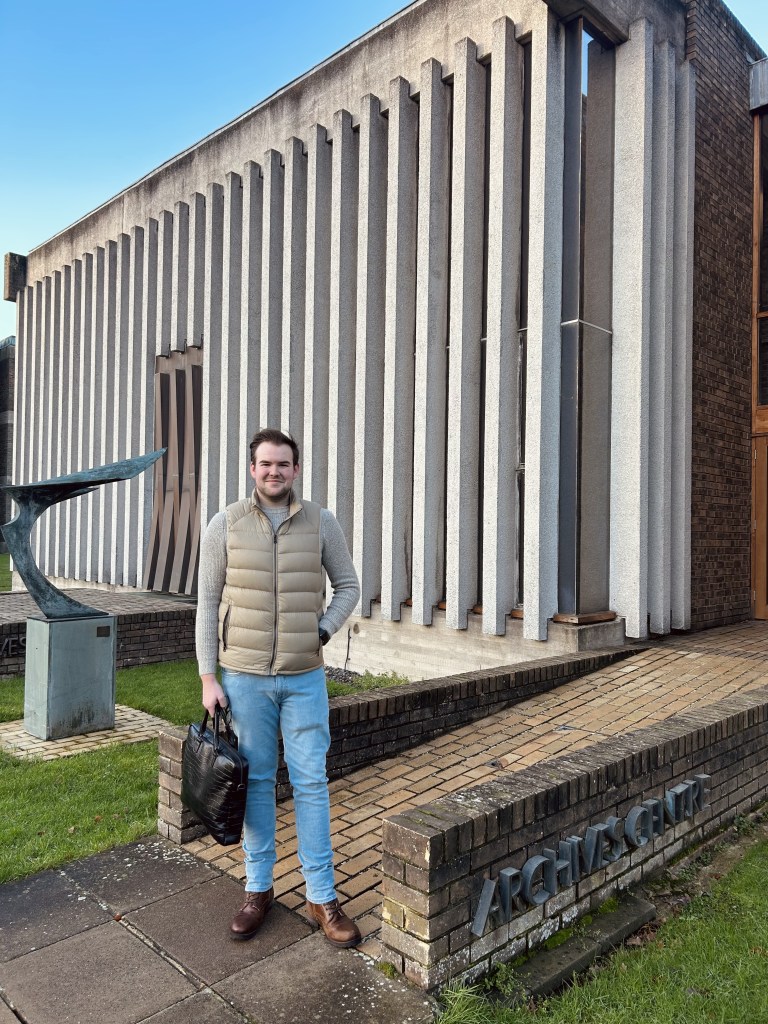
Walking into an archive can only be described as descending on an Aladdin’s Cave of primary material with each file containing hidden stories from the past. For my recent research trip, I went to both the Churchill Archives Centre and Cambridge University Library. Although this was not my first research trip, each time I visit an archive the excitement and anticipation of what I may unearth builds. The expression “a kid at Christmas” comes to mind. I spent a week between the two archives assessing a variety of primary material including letters, diaries, news reports, poems, photographs, and an unpublished autobiography. Each item assessed revealed something new to the reader whether that be through the events described or a change in the expression of language.
When assessing an item such as a letter, the reader must consider two things; 1) Who is reading it, and 2) Does this affect how it is written. The writer and recipient are the key focus here, but it must be considered that some prominent figures in society would be conscious about what they write fearing it may be read by the wrong person or may one day end up in an archive. The writer, subconsciously or not, will also adapt their writing style depending on the recipient. For example, We would not expect a politician to write in the same style in a letter to the Prime Minister as they would in a letter to their own child. Considering the language style is therefore key. The writer may appear to come across as aggressive to the modern-day reader but to the recipient, it is recognised as a mutually shared language they both understand and appreciated at a crucial time. Consequently, historians can have difficulty in interpreting these ever-changing language styles throughout a figure’s papers. When assessing a letter the reader must also imagine the recipient’s thoughts and reaction upon reading it for the first time and question whether they share in the emotions and opinions expressed. When a letter discusses a family matter, which much of the material I use does, then opinions can differ and it is then that the language styles change and tensions become apparent. Letters like these reveal to the reader inner-family relationships and how they operated day-to-day and changed over time adapting to the circumstances and environments around them.
Going to an archive for the first time can be quite a daunting experience. An archive contains many thousands of items, and your task is to select the key material which will enhance your work. Where do you start? I follow five rules when planning and going on a research trip which I will share with you now.
1) Locate your material in advance. – Nearly every archive will have an online catalogue of the material they have. Using keyword searches narrow down the focus of your search to identify the files which contain the key items for your project. Ordinarily, each file will have a description of what it contains, make sure to read it fully so you know what you are ordering. Many archives only provide a limited number of pre-ordered files, select the main files you need in the pre-order but also identify others you wish to view as you can often order more material on the day. Have the reference codes written down for the files you wish to order on the day to save you time.
2) Check if the material is available online – Some archives offer online services to access digitalised material. Although there is normally a charge for this if there is limited material you need from that archive, it is sometimes cheaper to view them online rather than travelling to the archive. You can also request material to be photographed and digitally sent to you for a fee.
3) Photograph material – Often a researcher will only have limited time in the archive therefore taking notes from each item viewed is not always feasible. Photographing all the material saves you time on the day and will allow you to order more files at a faster pace. It is always important to check if the archive has a fee for photography in advance of your visit.
4) Speak to the archivists – If there is something you are unsure of on the day speak to the archivist or a member of staff. Some materials will have certain equipment which needs to be used such as a book holder for diaries. Similarly, if you require advice on anything in advance of your visit do not hesitate to contact the archive. The archivists know the material and the archive better than anyone and will be more than happy to help.
5) Documentation – Ensure you know of any documentation, IDs or student cards you require on the day of your visit specific to individual archives. Most will require proof of identity on your first visit, thereafter you may need to take a research card for that archive. Make sure you have these with you before travelling.
I will be spending the next few months completing my primary research for my PhD thesis and travelling around the country to various archives. I have a lot of material to access, photograph, read and take notes on as I aim to provide new insights into my field of study.
 Elliot Clark HISTORIAN
Leave a comment