Andrew Liddle, Cheers, Mr Churchill!: Winston in Scotland (Edinburgh: Birlinn, 2022). RRP: £20.00
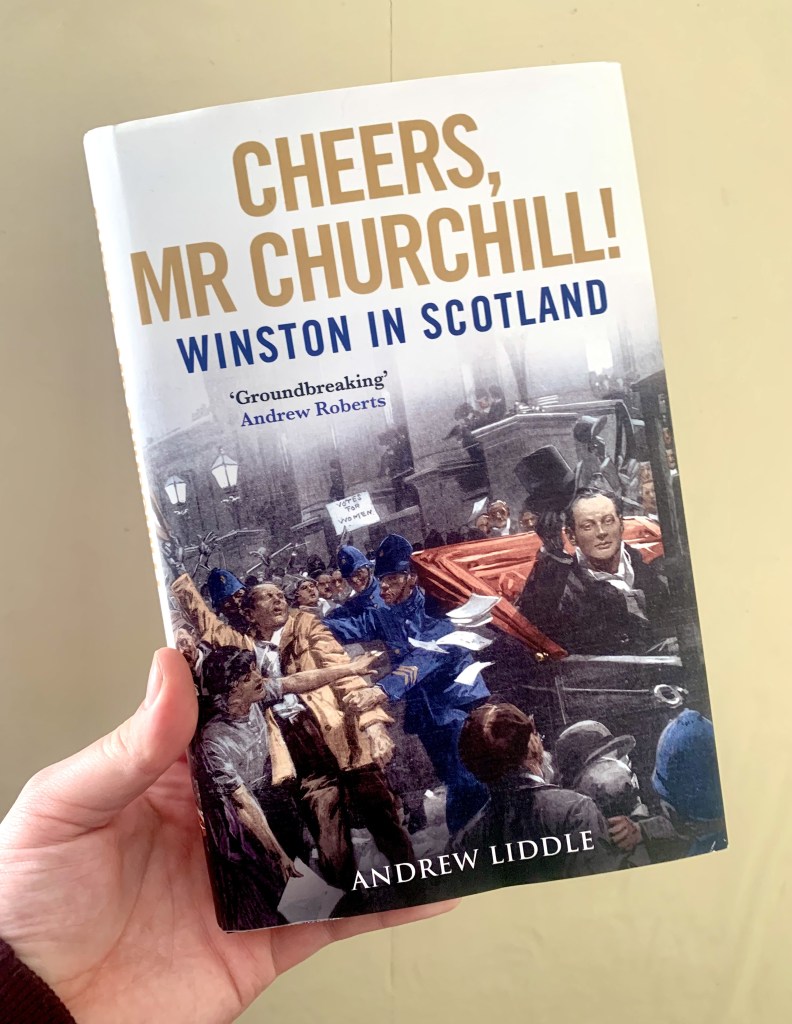
Churchill spent over 50 years at the helm of British politics, nearly 15 of which were spent as a Member of Parliament for Dundee, but despite this, Churchill’s relationship with Scotland is often neglected in historiography. Andrew Liddle, in his new book, Cheers, Mr Churchill, sets out to examine this often controversial relationship, demonstrating that despite the number of books already produced on Churchill’s life, there is still much more to say.
In this well-written and groundbreaking book, Liddle lifts the cover on the political campaign by assessing: the candidate selection process, the inner world of a party association, the working mechanisms of a campaign trail but also the rise of opponents, the political unions formed, the challenges from jeering crowds, and the threat of violence. In doing so the reader is presented with an image of the challenges Churchill would first face in 1908 as he fought his first election as the Liberal Candidate in Dundee, haunted still by his previous election loss in Manchester North West. Liddle furthers his study by evaluating the attitude, not only of Churchill but of his constituents as over the 15 years they would face the sacrifice and consequences of the Great War, a time which would throw the MP for Dundee into the middle of national controversy.
This is not only a story of Churchill, but of those relationships which formed to sustain and uphold his campaign in Dundee as he sought to reassert himself as a Cabinet Minister in London. The most significant being with his friend, confidant and mutual admirer, George Ritchie, who fought so hard to bring Churchill to Dundee, after his defeat in Machester North West, despite the unwillingness of the Liberal Association. Furthering this, Liddle demonstrates that politics is at times also made up of often unexpected relationships, including those with political opponents, identifying the union between Churchill and Labour MP Alexander Wilkie. A fascinating story in itself as the pair created a pact as the MPs for Dundee in this two-member constituency.
Often historians fail to appreciate and acknowledge the true importance Clementine Churchill played in her husband’s political campaigns. As the Churchills’ youngest daughter, Mary Soames, wrote, ‘Clementine possessed that most important ingredient in a politician’s make-up – good political instinct. She was also, on the whole, a better judge of people than [Churchill]’. Liddle proves this was the case in Dundee. In the 1922 election, with Churchill bedbound, it was Clementine who, alongside the Liberal Association, facilitated her husband’s campaign. Taking to the stage, Clementine demonstrated her skills as a public speaker, outshining Liberal officials, as Liddle reveals the influence and advisory Clementine was able to offer to the political world. Furthermore, Clementine, unlike some officials, and at times her husband, was able to connect with and understand the needs and wants of the constituents of Dundee. As a result, the Liberal voters put their trust not only in Churchill but in Clementine.
Through extensive research, Liddle examines this previously misunderstood relationship between Churchill and Scotland. Liddle successfully provides the reader with a crucial account of the hardship of campaigning during a time of global turbulence, evaluating both the support Churchill received in Dundee but also the criticism he received from the press, as well as accounts of the jeers and heckling heard from the crowd at nearly every campaign event. It demonstrates that this was not an easy seat to uphold as each election showed new challenges. For Churchill, it was not the ‘life seat’ he had longed for, but Dundee played a pivotal role in shaping the man Britain so famously knows today.
 Elliot Clark HISTORIAN
Leave a comment